
We usually locate intelligence in individuals. Schools assess individual learners, organizations recruit individual expertise, and discussions about artificial intelligence frequently compare what a machine produces with what a person knows or creates. This approach gives us useful measures, although it leaves another source of intelligence less visible: what people produce through interaction.
By Hans Sandkuhl, eolas – 14 minutes read
Research into collective intelligence has examined this question directly. A 2010 study involving 699 participants found evidence that some groups performed consistently well across different tasks, and their performance was not explained simply by having the most intelligent individual in the group. The finding provides an interesting starting point because it questions the assumption that a group’s intelligence is simply the sum of the intelligence of its members.
A recent exercise gave me a very small example. Marie-Claude and I exchanged random words to identify a subject worth exploring. Planet led to green, tree, mycelium, network, music, and eventually emotion. Neither of us started with collective intelligence as the intended subject. The exchange changed the information each person had available for the next response, and the resulting topic depended on both contributions. That does not prove collective intelligence, although it illustrates the mechanism I want to examine: one person’s contribution changes what another person produces.
Intelligence across biological networks
Mycelium provides an interesting place to start because its branching structures invite comparisons with neural networks. The visual resemblance is striking, while the comparison also makes it easy to attribute familiar human properties to a biological system that operates very differently.
Similar structures do not establish similar functions. A fungus exchanging resources or responding to environmental conditions does not therefore think like a human brain. The comparison becomes more useful if we treat it as a question rather than an explanation. Why do systems as different as fungal networks and brains rely on large numbers of interconnected components rather than a single point that performs every function?
A neuron alone does not explain human memory, perception, or reasoning. Those functions depend on activity across large numbers of neurons. Mycelium gives us another distributed biological system to observe without requiring us to claim that both systems produce intelligence in the same way. The interesting part lies in what changes once individual components exchange resources, information, or responses.
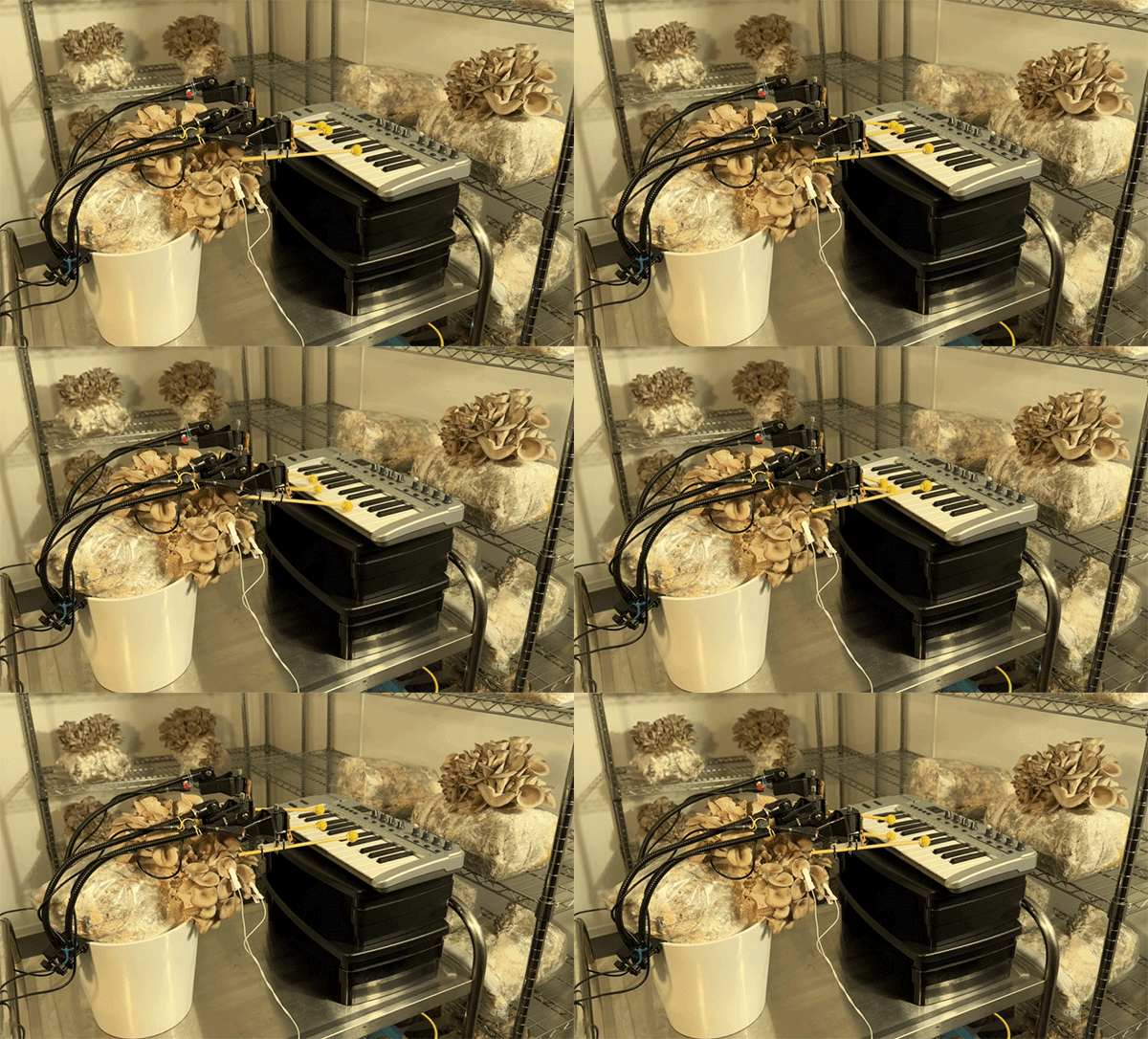
Bionic and the Wires takes this thought in an unexpected direction. The artistic project captures bioelectrical activity from plants and fungi and uses technology to translate those measurements into sound, movement, and visual outputs.
Calling the result “mushroom music” simplifies what actually happens. The organism produces electrical variations, sensors measure them, humans decide how data corresponds to musical parameters, machines execute those decisions, and listeners interpret the result. The final experience depends on several participants and technical choices. Looking for a single author therefore tells us less than examining what each participant contributes.
Music and intelligence between people
Music takes the question into a familiar human setting. Consider what happens at a concert, house party, choir, communal dance, or rave. People hear a common rhythm and adjust their timing and movement in response. They also observe the people around them, react to changes in the group, and alter their own behavior. In many forms of collective rhythmic dance, participants gradually coordinate their movements through repeated rhythm and observation, even without someone directing every movement. The same basic process remains recognizable on a contemporary dance floor.
Music provides several elements that shape this response, including the pace of a song, key, energy, danceability, and emotion. A change in any of them affects how people perceive a track and how they respond to it together. Rhythm and repetition provide common timing, while movement makes individual responses visible to everyone else. As more people adjust to the same rhythm and to each other, synchronization becomes a group behavior rather than a series of isolated reactions.
A good DJ and a dance floor make this exchange particularly visible. The DJ does more than select one track after another. Music tempo affects pace and physical intensity, key affects how naturally tracks work together, energy influences the intensity of the room, and danceability affects physical participation. Emotion adds another dimension because the same crowd may respond differently to something euphoric, familiar, intimate, or unexpected. The DJ observes these responses and adjusts subsequent choices. Participants simultaneously react to the music and to each other, so nobody determines the complete sequence independently, although every participant contributes something to it.
Something therefore develops at the collective level that becomes difficult to assign to one person. We may call it atmosphere, synchronization, shared emotion, or simply a successful night. The label interests me less than the process. The DJ makes choices based partly on the people present, while their movement, participation, withdrawal, and emotional responses provide information for what happens next. Communal dance shows that this process does not depend on modern technology or a DJ. Rhythm, repetition, observation, and physical participation already provide enough information for people to adjust their behavior to one another.

This is where the comparison with intelligence becomes more difficult. A thousand people moving to the same beat demonstrate coordination and a capacity to respond collectively to changes around them. They do not demonstrate that the group has become more intelligent. Music therefore gives us a useful boundary between acting together and thinking together, while showing how individual perception, physical response, and emotion influence what a group produces together.
Collective intelligence requires disagreement
The distinction becomes more interesting once people try to solve a problem rather than synchronize their movement. A group brings together different information, experiences, assumptions, and ways of interpreting the same situation. One person notices something another missed, someone else questions an accepted explanation, and another participant contributes experience from a different context. The eventual decision depends on what people do with these differences.
The same process also produces conformity. People repeat an accepted assumption, defer to authority, withhold contradictory information, or accept consensus because continuing to disagree becomes uncomfortable. A room full of people reaching the same conclusion therefore tells us little about the quality of the reasoning that produced it.
This is where I would place the boundary around collective intelligence. Did another participant introduce information that changed the decision? Did disagreement expose an error? Did people compare competing explanations before accepting one? Did the group produce something that its members working separately would have been less likely to produce?
The difference depends less on the number of people involved and more on whether people contribute different perspectives and question each other’s assumptions. Collective intelligence requires contribution, evaluation, and disagreement. Collective conformity occurs when people follow the group without examining its assumptions.
Learning between people
Education exposes the same question from another direction. We assess learners individually through tests, assignments, grades, and qualifications, while much of the development behind those results involves other people.
A learner asks a question and receives an explanation. Another learner introduces professional experience that changes how the group interprets the subject. Someone challenges an answer and requires others to reconsider it. A teacher adjusts an explanation after seeing that learners understood it differently than expected. Each person remains responsible for what they understand, although other participants influence what they encounter, question, and reconsider.
Learning also extends beyond access to information. In an earlier article, Why Knowledge Alone is no Longer Enough, I explored how information gains value through interpretation, application, and experience. Here, a different question interests me: what role do other people play in how we understand, question, and apply what we know? If learning depends partly on what other people contribute, what exactly are we measuring when we measure intelligence individually?
The question does not invalidate individual assessment. It asks what that assessment leaves outside its frame. A learner may eventually demonstrate knowledge alone while carrying the effects of hundreds of previous exchanges with teachers, colleagues, authors, friends, opponents, and other learners.
Does AI Make Us Think More Alike?
Artificial intelligence makes this question harder because another source now participates in exchanges that previously involved people. AI systems propose alternatives, summarize information, answer questions, compare arguments, and generate material that a person uses in subsequent decisions.
AI gives individuals access to more information and interpretations, while the value depends on how they use them. A person may use AI to question an assumption, compare interpretations, find an overlooked perspective, or test an argument. But they may also accept the first plausible response without examining its accuracy or considering other perspectives.
At group level, the distinction becomes even more interesting. If several people rely on similar systems, receive similar summaries, and accept generated answers without verification, greater access to information may reduce the differences that collective intelligence needs. Ten people supported by the same source do not necessarily bring ten independent perspectives into the discussion.
The distinction between collective intelligence and collective obedience becomes particularly relevant here. Collective intelligence depends on contribution, evaluation, disagreement, correction, and judgment. Collective obedience starts when people accept a conclusion without questioning who defined it or how it was reached.
AI therefore gives us another participant while also raising a question about how much judgment we are prepared to delegate. That question deserves its own examination because it extends beyond learning into groupthink, algorithmic recommendations, organizational decisions, and the way people establish what they consider reliable.
Intelligence between us
The question in the title therefore needs a qualified answer. Connection alone does not create intelligence. Mycelium does not become a brain because its structure resembles neural networks. People do not become collectively intelligent because they dance together. A classroom does not produce better learning simply because learners interact, and access to AI does not improve a group’s judgment simply because more information becomes available.
What people do with each other’s contributions provides a more useful way to examine the question. They introduce information, test interpretations, expose errors, adjust decisions, and apply experience that other participants do not possess. Under those conditions, intelligence no longer describes only what each individual brings to the group. It also describes what their interaction allows them to produce.
Perhaps the more useful question is not where intelligence resides, but what people do together that they could not have done as well alone.
Some sources of inspiration:
- Bionic and the Wires – The creative starting point that connects biological electrical activity, technology, music, and human interpretation.
- Evidence for a Collective Intelligence Factor in the Performance of Human Groups Woolley et al. (2010). The research foundation behind the opening question of whether group intelligence extends beyond individual intelligence.
- Musical Engagement as a Duet of Tight Synchrony and Loose Interpretability Rabinowitch (2023). Particularly relevant to your movement from musical synchronization toward coordination, individuality, and conformity.
- Why Knowledge Alone is no Longer Enough Hans Sandkuhl (2024) Mastering knowledge, alongside skills and experience, is critical for personal and professional development. Then, why is your knowledge falling dangerously behind?