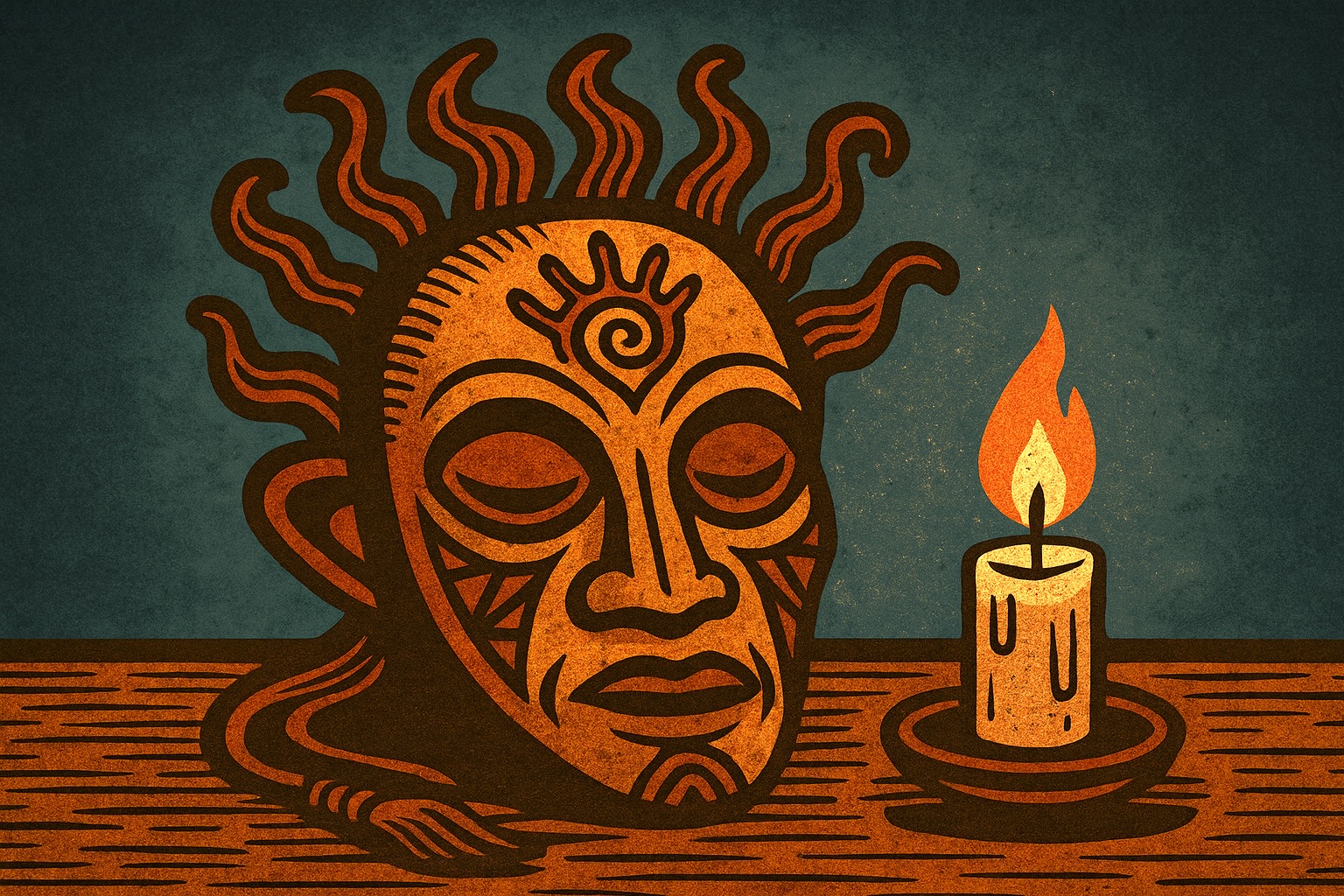
We are more connected than ever, yet deep down I feel as if the distance between people has grown. We favor speed over quality, cultural context holds less weight in our exchanges, and we talk more than we listen, but at what cost? Through a short series of articles we will explore how connection, empathy, and trust are shaped, or strained, by the systems we build, the choices we make, and the conversations we neglect.
By Hans Sandkuhl, eolas – 12 minutes read
It is 7:00 in the morning. I calmly light a stick of incense. Across town, a barista wipes the counter before making the first coffee, while another person snoozes the alarm clock. All gestures signal a beginning, small acts that will quietly set something in motion.
Rituals appear everywhere once you start looking for them. From lighting a candle before meditation to brewing that first cup of coffee at the corner café, each gesture carries intention. They can ease the mind, create meaning, or anchor us when things move too fast. The power of rituals lies in their ability to blend the practical and the poetic, physical and abstract, bridging our need for structure with our longing for connection.
The word “ritual” carries heavy imagery. Pop culture has shaped it through scenes of mystery and danger, secret societies, dark ceremonies, or ancient myths of sacrifice. These urban legends feed the idea that rituals belong to the strange, sacred or prohibited, far from ordinary life. That is not the kind of ritual this article explores. The rituals here are quiet, human, and visible in the simplest gestures: the way we begin a morning, share a meal, or return to stillness after noise.
The word “ritual” itself comes from the Latin ritus, meaning a proven way of performing a ceremony or observance. Over time, the term grew beyond religion to describe any act that carries intention and continuity.
At their core, rituals are deliberate acts that mark meaning in repetition. They turn ordinary gestures into signals of presence and awareness. Whether complex or simple, they work for each one of us in ways that reflect what we need most at that moment, may it be comfort, focus, or a sense of belonging.
Some rituals are sacred: the morning prayer, the Buddhist chant, or the daily act of gratitude. Others are cultural or deeply personal: a beauty ritual before a night out, the pre-sleep wind-down that signals safety to the body, or the small office customs that punctuate the day. In Paris, the unhurried coffee after clocking in; in Madrid, the eleven o’clock “almuerzo” with colleagues. These moments root the day in rhythm and shared presence.
I feel a distinction here matters: a ritual differs from a habit because it carries meaning. A habit is automatic, born of repetition. A ritual is intentional, even when simple. At its healthiest, it connects action with awareness. At its most distorted, it slides into compulsion, behaviors driven by anxiety rather than choice. The difference then lies in control and presence: a ritual reflects freedom, while obsessive repetition reflects fear.
Many gestures we call rituals may have lost their intention, becoming habits over time. Reading the newspaper at breakfast, taking the first sip of coffee before anything else, greeting with a hug, handshake or “bisou,” patting the dog before leaving for work, or checking messages the moment we wake up. All may feel ritualistic, yet most unfold without thought.
I decide to stop two stations before work and walk the rest as a way to care for my health. For now, that remains a ritual because I choose it consciously and feel its grounding effect. Over time, the gesture may continue, but the meaning behind it could disappear. A ritual carries intention; a habit simply repeats itself. What once marked a chosen moment of presence becomes a reflex. The difference is subtle but revealing: freedom of choice keeps a ritual alive, while routine alone turns it into an automatism.
Spiritual Rituals As Touchpoints With The Sacred
Many spiritual traditions embed rituals like meditation, chanting, lighting candles, pilgrimage, to signal transitions between the ordinary and the sacred. These acts offer a space to pause, to reflect, to re-enchant the world. In those moments, the ordinary lets go a bit, and something sacred feels more at reach.
For example, the Hindu practice of puja (‘reverence, honour, homage, adoration, or worship’) integrates offerings, mantras, and visualization to bring consciousness to devotional attention. In many Buddhist traditions, chanting or walking meditation anchors the practitioner to each breath or step, reminding them of impermanence, understanding that everything changes, and nothing lasts forever. Each ritual restores contact with something stable beneath change.
Ritual As Ground Of The Mind And Anchor To Reality
To some people, rituals act as an anchor or link to reality. When the world feels chaotic, noisy, a personal ritual like a morning stretch, journaling, or tea at sunrise, offers a moment of balance and calm. One neuroscientific view sees rituals as cues or signals to change mental modes: when we perform the ritual, the brain “knows” we are entering a moment of calm, focus, or reflection. One could say it is not the ritual itself that calms, but knowing we enter the moment that does.
This effect partly connects to Pavlovian conditioning, where repetition links a cue with a response. In the classic experiments, dogs learned to salivate at the sound of a bell because it predicted food. Human rituals work through similar associative pathways: lighting a candle may trigger calm, or sitting in a meditation space may hint at a moment of focus. The key difference lies in awareness and intention. Pavlovian reactions are automatic, they happen to us. Rituals, when healthy, are conscious choices that use the same neural mechanisms of association but direct them toward meaning and stability. In that sense, rituals engage the biology of habit while elevating it through intention and symbolism.
In mental health practices, therapists sometimes encourage rituals of transition, simple acts you do when leaving work and entering home life, to signal a boundary. That boundary helps reduce rumination and supports emotional reset. These small but intentional acts anchor everyday life to healthier patterns.
Beauty, Sleep, And Everyday Grounding
Beyond spiritual or religious contexts, rituals also exist in everyday routines. A beauty ritual is rarely about cosmetics alone. It is a moment to care for the self, to slow time, to transform an obligation into tenderness. A pre-sleep ritual, lowering the lights, reading a few pages, sipping herbal tea, tells the body the day is done. These are gestures of restoration that align body and mind.
Such rituals reveal that meaning is not only found in grand ceremonies but also in repeated private acts. They bring shape to our days and moments of calm that help us stay present.
Rituals and Mental Wellbeing with Psychological Roots
A ritual differs from a habit because it carries symbolic weight. The psychologist Ellen Langer studied rituals in everyday life and showed they raise awareness and intentionality. Rituals reduce anxiety: the structure reassures us, and the symbolic meaning gives emotional safety.
When people face uncertainty, for example before surgery or before performance, they often engage in personal rituals: lucky socks, a short prayer, a breathing routine. Studies show these rituals can reduce anxiety and improve performance (Norton & Gino, 2014). The reason: rituals simply make outcomes feel less random, restoring a feeling of control.
As a result, rituals support mental wellbeing by combining structure, meaning, and intention.
Rituals in Agile Teams and Organizational Culture
It surprises few that modern team methodologies borrow the language of ritual. Agile frameworks (Scrum, for example) call to daily standups, retrospectives, planning sessions. These are ritualized moments in the flow of work.
But they are not empty routines. When teams treat them as meaningful rituals, they anchor psychological safety, rhythm and synchronicity, and continuous improvement. The ritual of “retrospective” helps teams pause, reflect, and adapt. Over time these rituals shape how people think, speak, and act in that team, they can even shift an entire enterprise culture DNA.
In lean startup or design thinking, “sprints” and regular demo rituals impose cadence, feedback loops, and ritualized reflection. That consistency develops habits of inquiry, iteration, and humility. The ritual becomes part of the culture itself.
Rituals in Learning and Life Design
In coaching practices, I often prescribe learning rituals like thinking routines, daily reflections, or generative journaling. In learning organizations, “rituals of feedback” or “peer circles” reinforce continuous development, either through quizzes or team feedback.
In life design or personal development, people create rituals of identity change: writing “I am a writer” each morning, or greeting yourself in the mirror. Although I could not see myself repeating those motivational phrases from a post-it every morning, these rituals aim at shifting identity rather than just behavior. Over time, the symbol becomes real. So, does it work?
A ritual translates possibility into practice. Over time, repeated practice molds the neural pathways and habits of mind. It is how you shift your “operating system,” quietly but persistently.
Keeping Rituals Meaningful
Rituals will lose their power if they are performed mindlessly, or “just because”. The same task, repeated without reflection, becomes automatic and loses its meaning. And when a person reaches the point where they cannot live without a ritual, it no longer represents choice or freedom. What once steadied them, now begins to confine or imprison them. Therefore intention matters: one must pause, feel, embody meaning. Also, it is important to understand that not every ritual suits everyone. What anchors you, may scare or alienate someone else.
The same awareness applies to shared settings. In organizations, rituals also shape how people relate and feel included. Cultural sensitivity matters in that context, because imposing rituals without co-creation often develops resentment among those who do not feel part of the change. Every ritual needs a clear purpose that people can recognise as their own.
Rituals At The Heart Of It All
Rituals act as bridges: between inner landscape and outer action, between people and shared meaning, between intention and habit. The power of rituals is that they convert possibility into embodied structure.
If you design or re-design rituals in your life or teams, begin small. Choose one moment (start of day, team check-in), and invest in it. Ask: what feeling or value do I want here? Do I bring it fully each time? Over weeks, the ritual becomes a fingerprint on your mental well-being, your culture and your identity.
What small ritual might anchor your next week?
Some sources of inspiration:
- Rituals alleviate grieving for loved ones, lovers, and lotteries. Journal of Experimental Psychology: General, 143(1), 266–272. – https://doi.org/10.1037/a0031772
- Ellen Langer on how mindfulness can transform our well-being https://news.uchicago.edu/why-secret-health-lies-mind-body-connection#:~:text=Ellen%20Langer:%20Okay%2C%20so%20mindfulness,Yale%20all%20the%20way%20through.


